In this three-part nonprofit blog series and complementary training program, presented in partnership with JPMorganChase, the Greater New Orleans Foundation explores the role of governance during uncertain times. We believe that for nonprofits to thrive, board members must move beyond traditional ideas of oversight and toward Purpose-Driven Board Leadership, a governance framework introduced by our partners at BoardSource. In this second installment, our partners at BDO, a national firm that provides experienced financial management services and skilled capacity-building technical assistance using an approach tailored to individual organizations and their specific needs, reflect on the content of our recent webinar, “Financial Leadership for Board Members.” They offer strategic guidance on how board members can fully embrace their financial leadership roles. You can access the session’s presentation deck here. Learn more about future sessions in June and August and register here.
Navigating Uncertainty by Centering Nonprofit Financial Resilience: Three Strategies for Board Members
Hilda Polanco and Kate Piatt-Eckert, BDO Nonprofit & Grantmaking Advisory

Board members play a critical role in steering the organizations they serve through stormy seas and calm waters alike. For boards that are navigating significant uncertainty or see major changes on the horizon, focusing on financial resilience is essential. The work of stewarding an organization is a partnership between boards and leadership, and the strategies outlined here can help board members take proactive steps to be effective partners.
Financially resilient organizations are able to stay focused on the long-term while continually assessing and responding to current circumstances. Maintaining this balance between the future vision and the present need requires board members to fully understand their organization’s business model and focus on leveraging its strengths to adapt to change. Three strategies can help board members embrace their financial leadership roles:
1.Assess revenue diversity, flexibility, and predictability
To assess an organization’s risk landscape, board members should understand its revenue model, the risks associated with its revenue sources, and strategies for mitigating that risk. No single lens can provide a complete picture of the risk associated with an organization’s revenue model, but taken together, these three variables provide boards with a holistic view of the risk inherent in their budget.
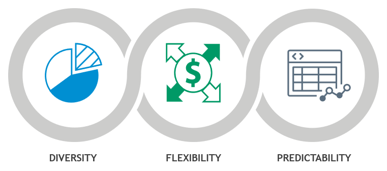
Three Dimensions of Nonprofit Revenue | © 2026 BDO USA, P.C. All rights reserved.
- Revenue diversity can be an effective strategy to reduce the risk associated with being dependent on one source of revenue, particularly if there is a concern about the stability of that funding source. The process of diversifying a revenue model, however, carries its own risk as new revenue streams generally require significant investment in infrastructure and staff time, and it often takes longer than expected for this investment to generate new revenue.
- Flexibility is an indicator of how much control an organization has over the use of its revenue. Unrestricted revenue is the most flexible and can be used to build reserves and navigate change, while revenue with donor-imposed restrictions is much less flexible.
- Predictability is a measure of an organization’s level of confidence in their revenue projections. The board plays a key role in determining its organization’s risk tolerance and establishing a confidence threshold for deciding which revenue should and should not be included in the annual budget, based on whether it has been confirmed, is likely to come in, or needs to be raised from sources unknown at the time of the budget presentation.
Before approving the annual budget, or throughout the year as boards adapt their budget projections to changing circumstances, the board should review and understand their revenue composition according to these three variables. Completing this Financial Risk Self-Assessment can be a great way to start the conversation. This Revenue Risk Analysis Tool is available to guide revenue model exploration.
2.Build capital for change and security.
A key component of financial resilience, Liquid Unrestricted Net Assets (LUNA) are the funds an organization has in available reserves to navigate change and move confidently into the future. LUNA can be thought of as an organization’s reserve or safety net. You can calculate your organization’s current LUNA balance and other key metrics using this tool.
When faced with lost funding, unexpected regulatory changes, or leadership transitions, LUNA provides organizations with the runway they need to adjust their programming strategy, recalibrate their business model, and weather short-term disruptions. It also gives organizations the security and resources needed to experiment with new strategies and take advantage of new opportunities.
Boards can use the annual budgeting process to focus on protecting or building LUNA.
- For organizations navigating uncertainty, boards can prioritize protecting their existing LUNA by understanding and mitigating the risk in their revenue model and by focusing on strategic cost containment – such as controlling expenses or increasing efficiencies.
- For organizations experiencing relative stability or growth, board members should prioritize strengthening LUNA by either budgeting an annual operating surplus designated for increased reserves or including a line item in their annual budget for planned contributions to a reserve fund.

3.Developan agile, ongoing planning practice
For resilient nonprofits, planning isn’t just a process that gets completed during annual budgeting or during formal strategic planning. It’s a well-honed practice that’s integrated into the day-to-day work of leading an organization. To help strengthen their organization’s planning muscle, boards need a clear understanding of their balance sheet and their business model, and they also need a shared language and regular cadence for discussing and assessing risks and opportunities. Board members can identify internal and external risks and changes, develop responsive plans for managing them, and transparently communicate about these plans as an ongoing practice. These can include a range of activities:
- Managing cash flow and evaluating cost-saving measures;
- Engaging in regular scenario planning;
- Exploring business model recalibration;
- Building strong compliance practices; and
- Considering alternative operating models, which might include sustained collaboration or transferring programmatic assets to another organization.
Focusing on financial resilience by assessing revenue composition, building capital for change and security, and building a strong planning practice allows nonprofit boards to center their organizations’ impact and continue serving their communities as they adapt to changing circumstances and leverage new opportunities. The tools and resources linked throughout this article, along with a treasure trove of templates and guidance designed to support nonprofits as they build financial resilience, are available at StrongNonprofits.org.
Linked Resources:
- LUNA
- Calculate LUNA and other Key Indicators of Financial Resilience
- Cash Flow Forecasting Templates
- Scenario Planning Tools
- Financial Risk Self-Assessment (Article and Tool)
- Funding Opportunity Assessment Tool
- Revenue Risk Analysis Tool